If your lawn constantly struggles — thinning, yellowing, growing unevenly — the issue may not be the grass at all.
It may be the soil.
Grass is only as strong as the foundation it grows in.
If you’re searching how to fix a lawn with poor soil quality, the first step is understanding that soil health controls everything:
Surface treatments won’t solve poor soil.
Structural correction will.
Let’s break down what poor soil looks like — and how to restore it properly.
Poor soil often reveals itself gradually.
Common warning signs include:
If multiple symptoms exist, the problem is likely below the surface.
Compaction is one of the most common soil issues.
Over time, pressure from foot traffic, mowing equipment, and natural settling compresses soil particles together.
Compacted soil:
When roots remain shallow, turf becomes fragile.
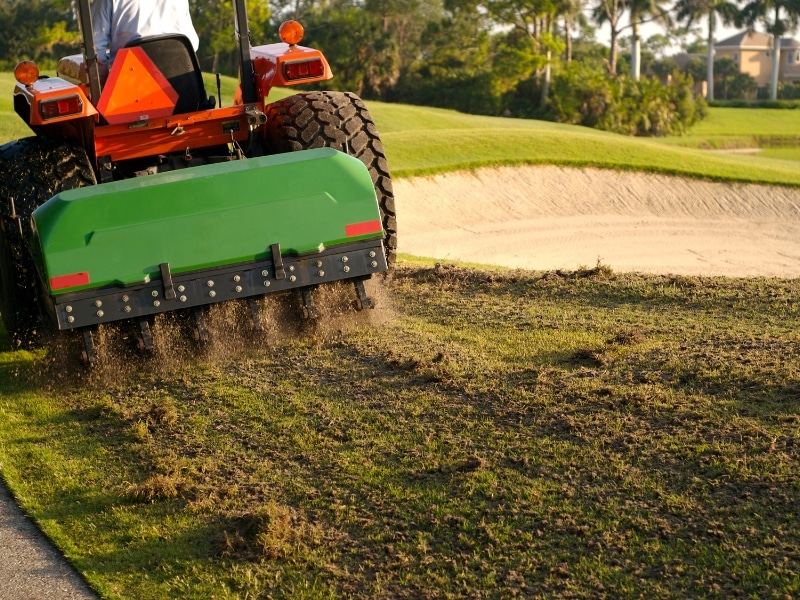
Lawn aeration relieves compaction and restores breathable soil conditions.
Healthy roots require oxygen as much as water.
Soil that drains too slowly or too quickly creates instability.
Low spots may stay saturated.
Higher areas may dry out rapidly.
This moisture imbalance leads to inconsistent turf performance.
Yard leveling redistributes soil and corrects subtle grading issues.
Balanced slope supports balanced hydration.
Healthy soil contains organic matter that:
If soil feels sandy, dry, or lifeless, it may lack essential structure.
Top dressing improves soil composition and strengthens the foundation for growth.
Too much organic buildup prevents roots from reaching soil properly.
Thatch acts as a barrier between grass and nutrients.
Professional lawn thatching removes buildup and restores direct soil connection.
Balanced soil contact improves nutrient efficiency.
In some yards, soil depth varies due to construction, erosion, or settling.
Shallow areas struggle to support strong turf.
Leveling and soil redistribution restore consistent depth across the yard.
Uniform depth improves overall stability.
Many homeowners attempt to correct poor lawn performance by applying more fertilizer.
But if soil is compacted or imbalanced:
Nutrients are only effective when soil structure supports absorption.
Fixing structure first ensures long-term improvement.
Correcting soil quality typically involves:
Each step builds stability from the ground up.
When soil structure improves, you’ll notice:
Healthy soil supports resilient grass.
Resilient grass maintains appearance year-round.
Grass health begins below the surface.
If your lawn struggles repeatedly despite surface efforts, the soil likely needs attention.
Fix the foundation, and growth follows.

If you suspect poor soil quality is limiting your lawn’s health, schedule your free consultation and let our team evaluate compaction, grading, and soil structure to restore balance.