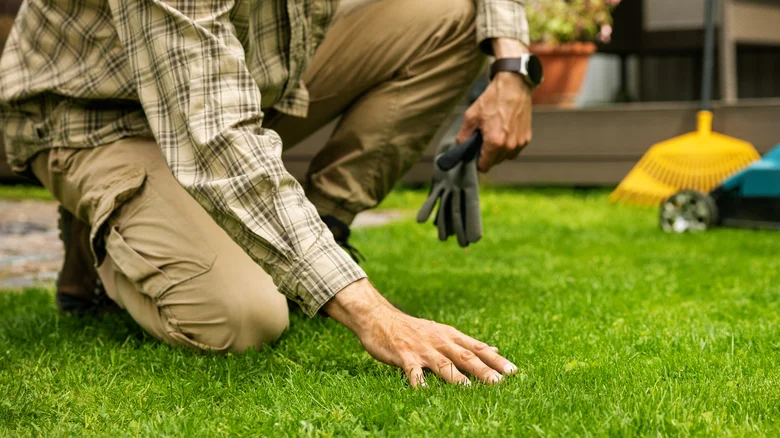
If your lawn feels soft, bouncy, or spongy under your feet, that’s not normal.
Healthy turf should feel firm and stable — not cushiony.
A spongy lawn is usually a warning sign that something beneath the surface isn’t functioning properly.
If you’ve been asking, “Why does my lawn feel soft?” here’s what’s actually happening.
The most common reason for a spongy lawn is excessive thatch.
Thatch is a layer of:
That accumulates between the soil and living grass.
A thin layer is fine.
But when thatch becomes too thick, it creates a soft barrier.
This prevents proper soil contact and makes the lawn feel unstable.
Professional lawn thatching service removes this buildup and restores firmness.
Spongy grass can also indicate poor drainage.
If water cannot absorb evenly into the soil, it may remain near the surface.
This leads to:
Correcting lawn drainage problems and improving grading helps water move properly through the soil.
Balanced drainage restores stability.
It may sound counterintuitive, but compacted soil can also contribute to surface softness.
When soil is too dense:
Lawn aeration relieves compaction and allows water and oxygen to reach deeper roots.
Stronger roots create firmer turf.
Grass anchored only in a thatch layer — instead of soil — develops weak roots.
Shallow roots:
Once thatch is removed and soil structure improves, roots grow deeper and turf becomes more stable.
A soft lawn may seem harmless.
But over time, it can lead to:
The longer thatch and drainage issues remain uncorrected, the harder recovery becomes.
Early intervention prevents long-term damage.
Fixing a soft lawn usually requires:
Surface fixes like watering less or cutting shorter won’t solve structural problems.
The issue is beneath the grass.
A healthy lawn should feel:
Firm turf signals strong roots and proper soil contact.
Sponginess signals imbalance.
Correct the structure — and the feel improves naturally.
If your lawn feels soft or spongy, don’t ignore it.
It’s often one of the first signs your yard needs structural attention.
Addressing the issue early protects long-term turf health.

If your lawn feels unstable or spongy, schedule your free consultation and let our team evaluate whether professional lawn thatching or soil correction is needed to restore firmness and strength.